PAULO NAZARETH
Ora pro nobis
[Scroll down for English]
Todas las obras que forman parte de la exposición "Ora Pro Nobis" tienen un cordón umbilical que las une a la madre. La lengua materna, la ausencia e invocación de la madre, el amor de madre o la madre naturaleza. Y en la trayectoria de Paulo Nazareth (1977, Governador Valadares, Minas Gerais, Brasil), lo familiar, así como lo artístico, lo religioso, y lo medioambiental, es político.
El linaje femenino del artista está presente desde su propio apellido, que adopta del nombre de su abuela desaparecida, hasta en las fotografías que le hace a su madre. Ambas apariciones son un desafío a sus ausencias. Su abuela, Nazareth Cassiano de Jesus, trabajaba como criada para una familia de latifundistas con granjas en tierras habitadas por la etnia indígena Borum. Se quedó embarazada, y tras dar a luz, fue despojada de su bebé por la familia para la que trabajaba e ingresada en un hospital psiquiátrico en Barbacena, Minas Gerais, donde su rastro se perdió y no volvió a saberse nada más de ella. De su bebé sí: creció y sustituyó a su madre en las labores domésticas, en condiciones laborales de explotación. Es Ana Gonçalves da Silva, la madre de Paulo.
A Paulo no sólo le motiva la reivindicación y homenaje a su madre y abuela: su búsqueda de las huellas borradas de sus pasados es más profunda. La serie fotográfica Bocotudos Heritage inmortaliza a su madre en el Museo del Hombre de París posando con retratos exotizantes de personas de la etnia Borum Krenak, grupo indígena perseguido, confinado y desterrado por los colonizadores portugueses de la que ella es descendiente. Un intento por reconectar con una memoria y un legado arrancados. En esta exposición hay una invitación a invocar y compartir el recuerdo de nuestras progenitoras. En MAMA, el Museo de la Madre, los visitantes dibujan el rostro de sus madres haciéndolas reaparecer sobre el papel, convirtiendo el espacio en parte monumento, parte archivo, y parte tributo colectivo a todas nuestras mamás.
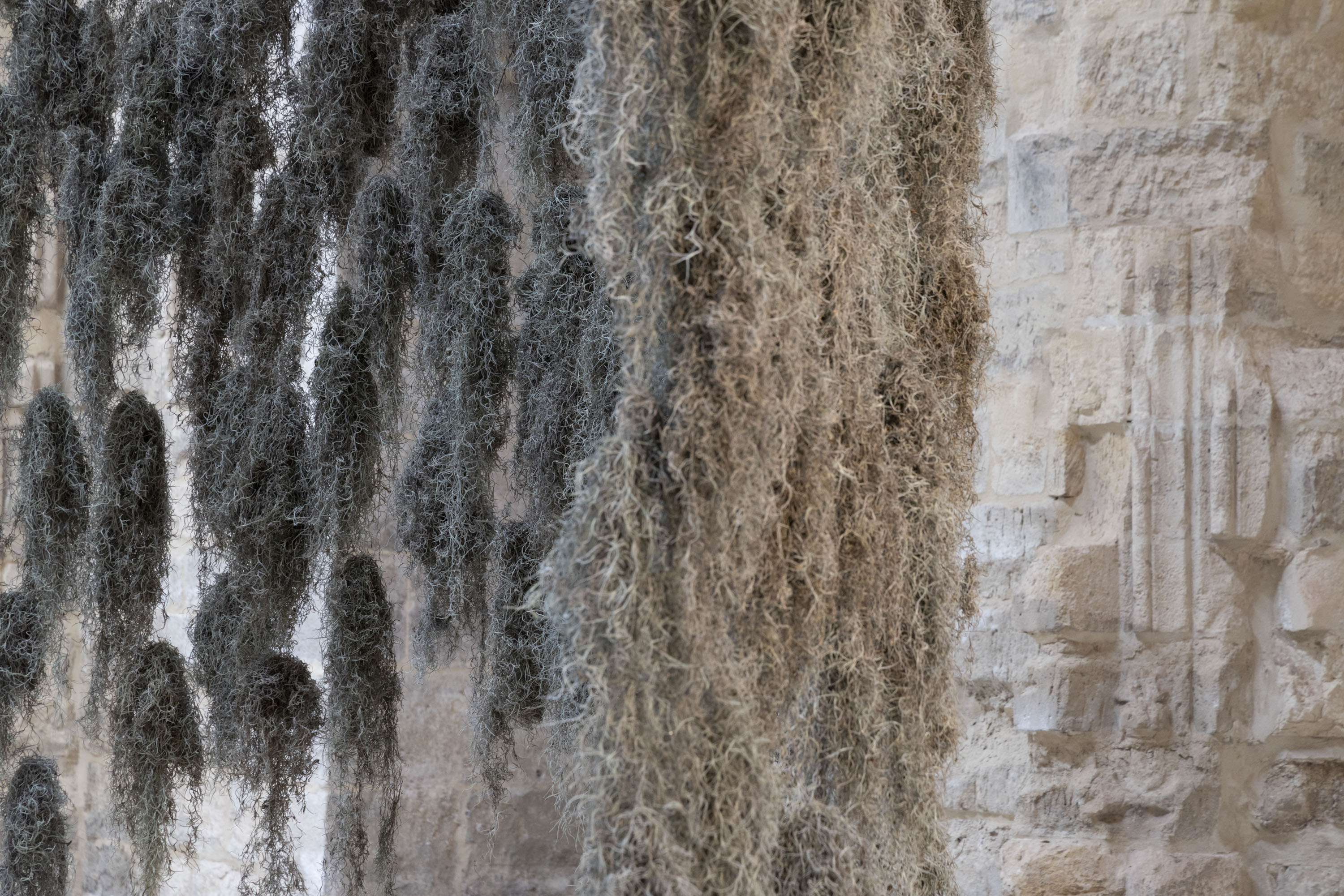
“Ora pro nobis”, latín de la voz ruega por nosotros, es la oración que implora por la protección de la Virgen María, y es también como se denomina en Brasil a una especie de cactus, Pereskia Aculeata. La llaman así por su origen, ligado a la ingesta de esta planta que brotaba cerca de las iglesias de Minas Gerais, región en la que convivía la evangelización con el trabajo en las minas de esclavos africanos. En la instalación de la Capilla de los Condes de Fuensaldaña, Paulo Nazareth hace convivir la Ora pro nobis con otras dos plantas: la Tillandsia usneoides, denominada barbe espagnol por los franceses porque les recordaba a las barbas de los colonizadores españoles, y la Euphorbia milii, llamada Corona de Cristo y Corona de Nuestra Señora por sus espinas. La etimología y sus adaptaciones sociales le sirven al artista para componer este sitio específico en el que se entrelazan historias de aculturación, adaptación y ofrenda.
Se exhibe también en esta muestra un conjunto de bordados que hace alusión al origen y uso de la lengua materna en Latinoamérica, en relación con lo doméstico. La frase “amor de madre” es tejida sobre paños de cocina de la madre del artista, traducida en latín, vasco y suajili, como parte de un proyecto mayor que quiere abarcar su traducción en todas las lenguas vivas y muertas. Otros bordados hacen referencia a la aplicación popular en algunos países latinoamericanos de la palabra madre en sentido negativo (tu madre, madreado), y otros, a ese origen colonial de una lengua que fue, primero, paterna, y actualmente, materna: “Las lenguas latinas que llegaron a América son una lengua paterna”, afirma Paulo, quien defiende esa idea sobre la base de que los primeros colonizadores fueron en su mayoría hombres, y los hijos mestizos de la colonización, de madres indígenas, aprendieron las lenguas latinas enseñados por los religiosos de órdenes católicas: los padres.
En el claustro del museo se escuchan voces de niños de la comunidad Guarani-Kaiowá: es una pieza sonora que incide en esa adaptación e imposición de las lenguas latinas sobre las indígenas. En el audio, compartimos el proceso de aprendizaje por parte de Paulo de las palabras que usan hoy en día en la tribu, algunas provenientes del español, otras del francés y otras del portugués.
La religión católica es la protagonista de los cuatro videos. La historia de imposición y aceptación latente en el audiovisual que registra a la madre del artista rezando un Ave María traducido al portugués, la persecución de dos camiones con la figura de la Virgen María pintada en sus puertas, o el ascenso y posterior desaparición del propio Paulo Nazareth al escalar un árbol, el iroko, originario de África, cuyas enormes raíces abrazan una iglesia. Madre, la religión, el colonialismo, los ancestros, sus ausencias y reapariciones son las palabras clave para interpretar estas creaciones.
All the pieces featured in the exhibition ‘Ora Pro Nobis’ are linked to the figure of the mother by an umbilical cord: the mother tongue, the absence and invocation of the mother, a mother’s love and Mother Nature. In the career of Paulo Nazareth (1977, Governador Valadares, Minas Gerais, Brazil), the familiar, the artistic, the religious and the environmental are all political.
The artist’s female lineage is evident from his own surname – which he took from his missing grandmother – right through to the photographs he takes of his mother. Both of these representations challenge their absence. His grandmother, Nazareth Cassiano de Jesus, worked as a domestic servant for a family of large-scale landowners with farms on land inhabited by the Borum indigenous people. She became pregnant, and after giving birth, her baby was taken from her by the family she worked for and she was admitted to a psychiatric hospital in Barbacena, Minas Gerais, where all trace of her was lost and nothing more was ever heard of her. As for her baby: she grew up and took her mother’s place in domestic work, under abusive working conditions. This is Ana Gonçalves da Silva, Paulo’s mother.
Paulo is motivated not only by the desire to vindicate and honour his mother and grandmother: his search for the lost traces of their past runs much deeper than this. The photographic series Botocudos Heritage immortalises his mother at the Musée de l’Homme in Paris, posing alongside exotic portraits of members of the Borum Krenak ethnic group – an indigenous people persecuted, confined and exiled by the Portuguese colonisers, and from whom she is descended. This is an attempt to reconnect with a memory and a legacy that were both torn away. The exhibition invites us to invoke and share the memory of our own mothers. At MAMA, the Museum of the Mother, visitors draw their mothers’ faces, bringing them back to life on paper, transforming the space into part monument, part archive and part collective tribute to all our mothers.
“Ora pro nobis”, which is Latin for ‘pray for us’, is a prayer that implores the protection of the Virgin Mary, and is also the name given in Brazil to a species of cactus, Pereskia aculeata. It is so named because of its origins, related to the consumption of this plant which grew near the churches of Minas Gerais, a region where evangelisation coexisted with the labour of African slaves in the mines. In the installation at the Chapel of the Counts of Fuensaldaña, Paulo Nazareth brings together the ‘Ora pro nobis’ with two other plants: Tillandsia usneoides, known as ‘barbe espagnol’ by the French because it reminded them of the beards of the Spanish colonisers, and Euphorbia milii, called the ‘Crown of Christ’ and the ‘Crown of Our Lady’ because of its thorns. The artist draws on etymology and its social adaptations to compose this site-specific piece, in which stories of acculturation, adaptation and offering are all interwoven.
Also on display in the exhibition is a series of embroideries that allude to the origin and use of the mother tongue in Latin America, in relation to the domestic sphere. The phrase “a mother’s love” is embroidered onto tea towels belonging to the artist’s mother, translated into Latin, Basque and Swahili, as part of a larger project that aims to cover the translation of the phrase into all living and dead languages. Other embroideries refer to the popular use of the word ‘mother’ in a negative sense (‘tu madre’, ‘madreado’) in some Latin American countries, whilst others allude to the colonial origins of a language that was initially paternal but is now maternal: “The Romance languages that came to the Americas are paternal”, asserts Paulo, who defends this idea on the basis that the first colonisers were mostly men, and the mixed-race children of colonisation, born to indigenous mothers, learnt the Romance languages taught to them by members of Catholic religious orders: priests.
The Catholic faith takes centre stage in all four videos. The narrative of imposition and latent acceptance in the audiovisual work – which captures the artist’s mother reciting a Hail Mary translated into Portuguese, the pursuit of two lorries with the figure of the Virgin Mary painted on their doors, and the ascent and subsequent disappearance of Paulo Nazareth himself as he climbs a tree, the iroko, native to Africa, whose enormous roots embrace a church. Mother, religion, colonialism, ancestors, their absences and reappearances are the key concepts for interpreting these works of art.