El trabajo de Maria Tinaut es esencialmente procesual. Para esta exposición ha regresado a Tierra de Campos, concretamente a Villacidaler, su pueblo materno, donde ha realizado una serie de acciones consistentes en arrastrar lo que podríamos definir como un apero artístico compuesto por listones de madera y láminas transparentes adhesivas. La artista recoge así registra la acción de caminar en el espacio familiar, que es un espacio abierto a la inmensidad de un cielo inacotable, cuyo color, ya imaginarán, ha denominado Azul Castilla. Esta es una primera fase del trabajo, un quehacer físico que responde a la constancia de un cuerpo que se desplaza dejando marca, una marca de la que a la vez se apropia. Esta cuestión, la del rastro que hace suyo llevándolo consigo, es determinante en el trabajo y la poética de María TInaut.
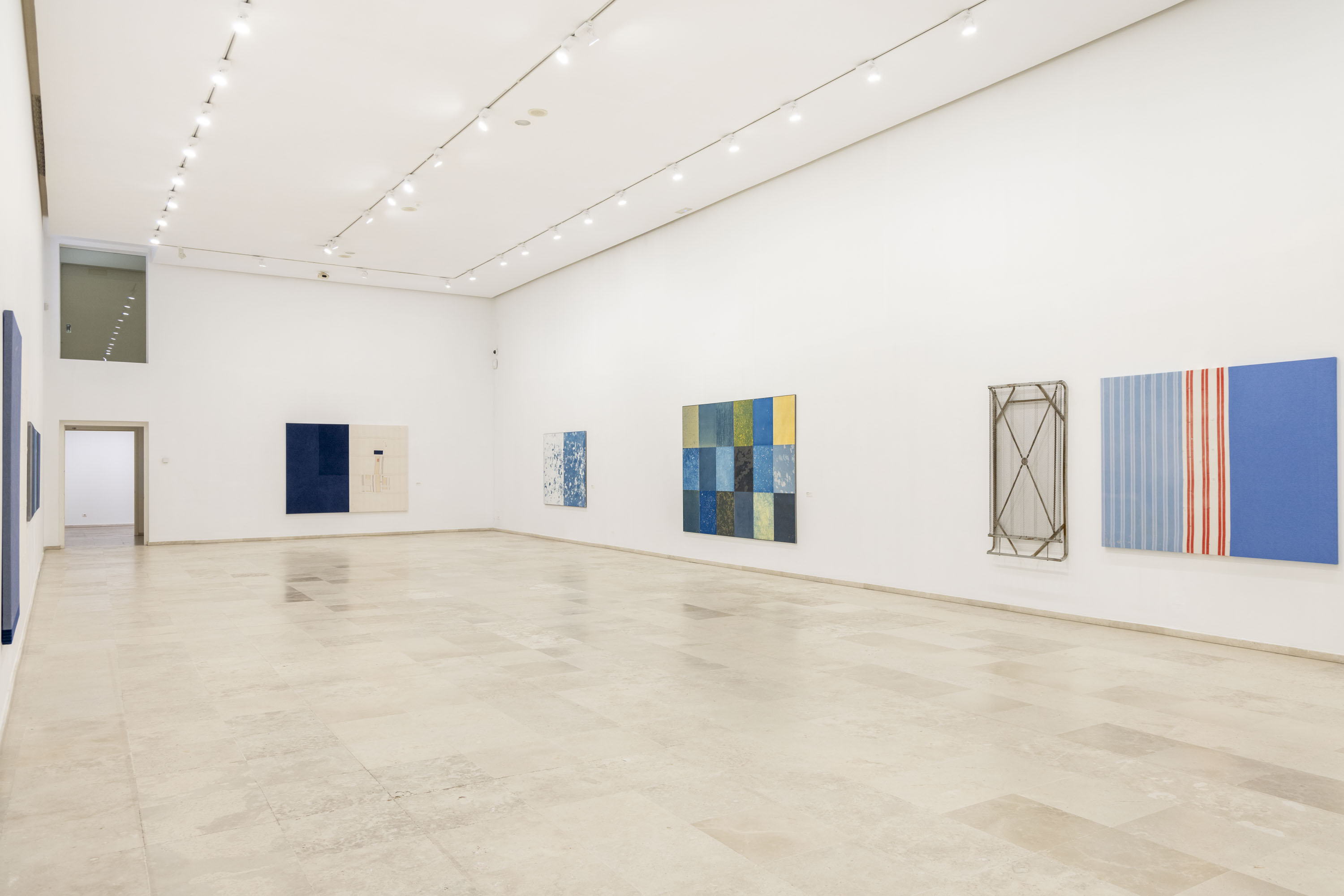
Un seguido momento es aquel que ve fraguar las imágenes que vemos en esta exposición, y éste ocurre en el estudio de la artista. Aquí se sirve del cianotipo, una técnica que nace del Azul de Prusia, y de la que se sirve para que todo lo registrado en Tierra de Campos configure una constelación gestual que apele a lo pictórico, como si de una acción expresiva sobre una superficie se tratara. Pero aquí nada se pinta. Tampoco hay nada fotografiado. Tinaut apela a disciplinas artísticas que sin embargo desoye, pues pinta sin pintar, fotografía sin cámara, y porque, en definitiva, no hay otro origen en su creación que no sea el de estar en el lugar y explorar su memoria. Vemos en la sala un buen número de obras que, a primera vista, podrían parecer cuadros pero en realidad son los tamaños de las estructuras de las camas, y sus superficies, los tejidos que las cubren. De ellos se sirve Tinaut para desarrollar sus ejercicios de aplicación de color, del cosido y ensamblaje de las telas, que delatan siempre la memoria de un cuerpo ya ausente. Dos de estas estructuras reales, procedentes de la casa materna, se exhiben aquí junto al resto de las piezas. Aluden a la escala humana, al espacio doméstico y a la memoria del acervo familiar.
MARÍA TINAUT
Castilian Blue
This exhibition by María Tinaut, which she has entitled Castilian Blue, has a wide range of meanings; it broadens the scope of the toponymy of a colour which throughout history has been associated with a place or a space: Prussian blue, ultramarine blue… All of María Tinaut’s recent work is built upon a study of the colour blue: the exhibition in our Gallery 8 is predominantly blue, and yet Castilian Blue is not derived from pigments characteristic of this region, which is where she comes from. This is the paradox that endows the exhibition with both its strength and meaning.
Maria Tinaut’s work is essentially process-based. For this exhibition, she went back to Tierra de Campos, more specifically to Villacidaler, her mother’s village, where she carried out a series of actions involving dragging along what we might describe as an artistic implement made up of wooden slats and transparent adhesive sheets. The artist thus captured and recorded the act of walking through a familiar space – a space open to the immensity of a boundless sky, the colour of which, as you might imagine, she has named Castilian Blue. This is the first phase of the work: a physical endeavour that responds to the persistence of a body moving whilst leaving a mark – a mark which at the same time she makes her own. This very issue – that of the trail she makes her own by carrying it with her – is central to the work and poetics of María Tinaut.
A subsequent moment is the one in which the images we see in this exhibition take shape; this occurs in the artist’s studio. Here she makes use of the cyanotype, a technique derived from Prussian blue, which she employs so that everything recorded in Tierra de Campos forms a gestural constellation that appeals to the pictorial, as if it were an expressive action on a surface. Yet nothing is painted here. Nor is anything photographed. Tinaut draws on artistic disciplines which she nevertheless disregards, for she paints without painting, photographs without a camera, and because, ultimately, there is no other source for her creation than that of being in the place and exploring its memory.
In the gallery, we see a number of pieces which at first glance, might appear to be paintings but are in fact the dimensions of bed frames, and their surfaces, the fabrics that cover them. Tinaut uses them to develop her exercises in the application of colour, stitching and the assembly of fabrics, which always reveal the memory of a body that is no longer there. Two of these real bed frames, from her mother’s house, are exhibited here alongside the rest of the pieces. They allude to the human scale, to domestic space and to the memory of her family heritage.