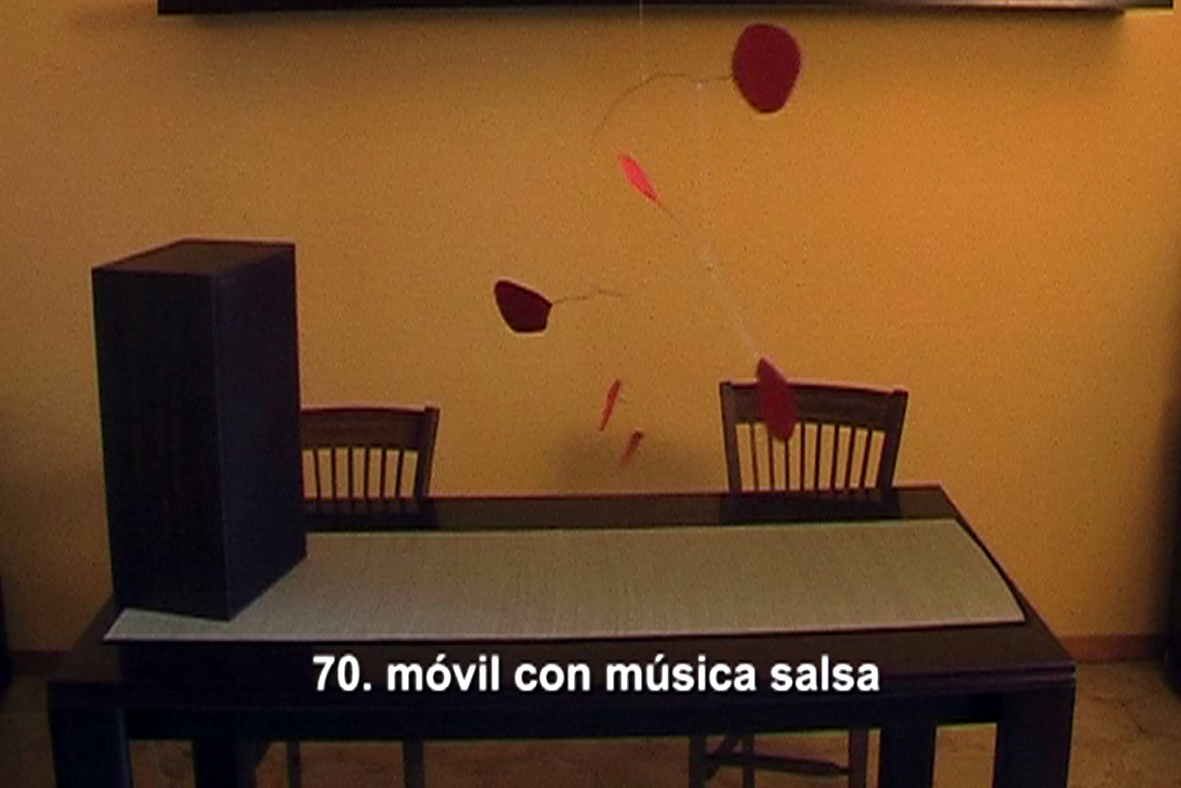
“Acciones en casa”, es un vídeo grabado con métodos precarios y en un contexto doméstico por los propios David y Marc en un piso del barrio del Ensanche, en Barcelona. El video es pretendidamente sencillo en su planteamiento y es mordaz y cáustico en el relato que ofrece. Sigue los procedimientos del arte conceptual, tanto en el de primera generación como en el de aquellos artistas que, ya en los años noventa, revisaron el conceptual canónico dotándole de sentido del humor -o, mejor, restándole solemnidad-, como Fischli/Weiss, curiosamente otro tándem, suizo en este caso, de quien toman, además, la estructura del video (los suizos fueron una influencia importante en la obra de los catalanes). Una célebre obra de Fischli/Weiss es How to work better, que consiste básicamente en un texto en forma de listado con las diez cosas que un artista necesita para trabajar en circunstancias razonables, una suerte de To-Do List. El vídeo de Bestué/Vives toma esta idea de listado y presenta una secuencia de acciones domésticas inscritas en el absurdo, como “robar una planta del vestíbulo y exhibirla en un balcón” o “tener una cita en el pasillo”, que tienen precisamente en esa condición su cualidad subversiva, pues acuden con espontaneidad a iconos del arte del siglo pasado, enturbiando el destello aurático de la Modernidad.
El pase de este video ya clásico en las celebraciones del Día y la Noche Internacional de los Museos también tiene la motivación de situarse en la bisagra entre dos de las propuestas que estos meses pueden verse en el museo. La tradición moderna de la escultura tiene un gran arraigo en Cataluña, de ahí la clara alusión a Calder en una de las acciones, en la que Bestué/Vives sitúan una escultura móvil al son de un conocido hit latino. Ahí se deslizan las esculturas cinéticas de Núria Fuster que pueden verse en la planta baja y las piezas de caña de ese otro “calderiano”, como se dio en llamar a Moisès Villèlia, que pueden verse en la tercera planta.
DAVID BESTUÉ /MARC VIVES
ACCIONES EN CASA, 2005
33’
Colección MUSAC
The video Acciones en casa, (“Things to do at Home”), conceived and produced by David Bestué and Marc Vives, caused a real sensation when it was released two decades ago. Even though the word “sensation” is generally used to describe grandiose events, astounding occurrences or milestones of monumental scale, this sensation was all the more remarkable as it was the polar opposite of anything you could describe as bombastic. We are talking 2005. The mortgage crisis had not yet struck, and there were still no signs of the financial collapse that was about to hit and dramatically transform all our social structures, including, of course, artistic creation. And yet Bestué and Vives’ practice already held a way of thinking about art that foreshadowed what was to come: a scenario of great economic hardship for artists, who saw their options for producing works of art dwindle, just as museums and art centres saw their budgets slashed.
Acciones en casa is a video recorded using rudimentary methods in a domestic setting by David and Marc in a flat in the Ensanche district of Barcelona. The video is deliberately simple in its approach; yet it is scathing and caustic in the narrative it presents. It follows the procedures of conceptual art, both those of the first generation and those of the artists who, by the 1990s, had revisited canonical conceptual art by imbuing it with a sense of humour – or rather, by stripping it of its solemnity – such as Fischli/Weiss, curiously enough another duo, Swiss in this case, from whom they also borrow the video’s structure (the Swiss were a significant influence on the Catalans’ work). A well-known piece by Fischli/Weiss is How to work better, which basically consists of a text in the form of a list of the ten things an artist needs to work under reasonable circumstances, a sort of to-do list. Bestué/Vives’ video takes this idea of a list and presents a sequence of domestic actions steeped in the absurd, such as “stealing a plant from the hall and displaying it on a balcony” or “having a date in the corridor”, which derive their subversive quality precisely from this condition, as they spontaneously draw on icons of the art of last century, clouding any auratic glow it might have.
The screening of this video, a true living classic, during the International Museum Day and Night celebrations may also function as a link between the different projects that are currently on show in the museum. The modern tradition in sculpture is deeply rooted in the Catalan context. Tis is why there is a nod to Alexander Calder (and to a somewhat unexpected Latin music) in one of the “actions”. Under this light we may see Nùria Fuster’s kinetic work in the ground floor’s Room 9, and the wooden pieces of the third floor, made by Moisès Villèlia, who once was called “calderian” as he followed the American artist’s path.